Organization had outgrown applications built for specific use cases.
Field and headquarters staff used “home-grown” applications to address very specific tasks which worked for their purpose at the time they were built many years ago. The plan was to figure out how to consolidate those applications in a way that made sense inside a cloud-based product.
The frame.
Where we began and who was affected.
Before embarking on this endeavor, we talked with users at headquarters and various locations across the country to understand what was working, what was not and what additional things they would like to do with the new system once built.
The organization’s structure had evolved beyond what the original "home-grown" applications could support. Additionally, in several cases, key data was only accessible or editable by those at headquarters because original workflow did not require the frontline to have access. These redundant, siloed applications were out-dated and would not move the organization toward their vision of a unified workforce working toward the same goals.
To ensure usability and adoption, UX launched a comprehensive initiative to bridge the information and communication gap. The goal was to design a unified, intuitive experience that empowered frontline associates with real-time access to data and tools—ultimately strengthening alignment and performance across all levels of the organization.
"These applications were built for a specific use case for an organization with fewer employees and requirements than we have now." Product Owner
Who I talked to.
I conducted workshops with the Product Owner and key department leaders to understand where the overlaps existed. I worked with our UX designer to map out the current state and our UX researcher to plan out the research approach.
Workshop details
- Built the framework for the workshop in Mural
- Conducted 3 virtual workshops total with key stakeholders and moderated discussions
- Aligned on the problem statement
- Determined the MVP scope and subsequent priorities
What we found.
These are the key insights from the workshop and interviews.
Teams handoffs were not smooth and created delays in information retrieval.
Each team was working in systemic isolation requiring manual coordination through email or phone calls.
Some data had no single source of truth and was entered in multiple systems.
Teams were maintaining duplicate information across different platforms sometimes in different formats making reporting challenging.
Overall intake process was unclear to those submitting requests.
Location managers were often unsure about the correct way to submit a request as the process and intake form used varied depending on the situation.
Where we landed.
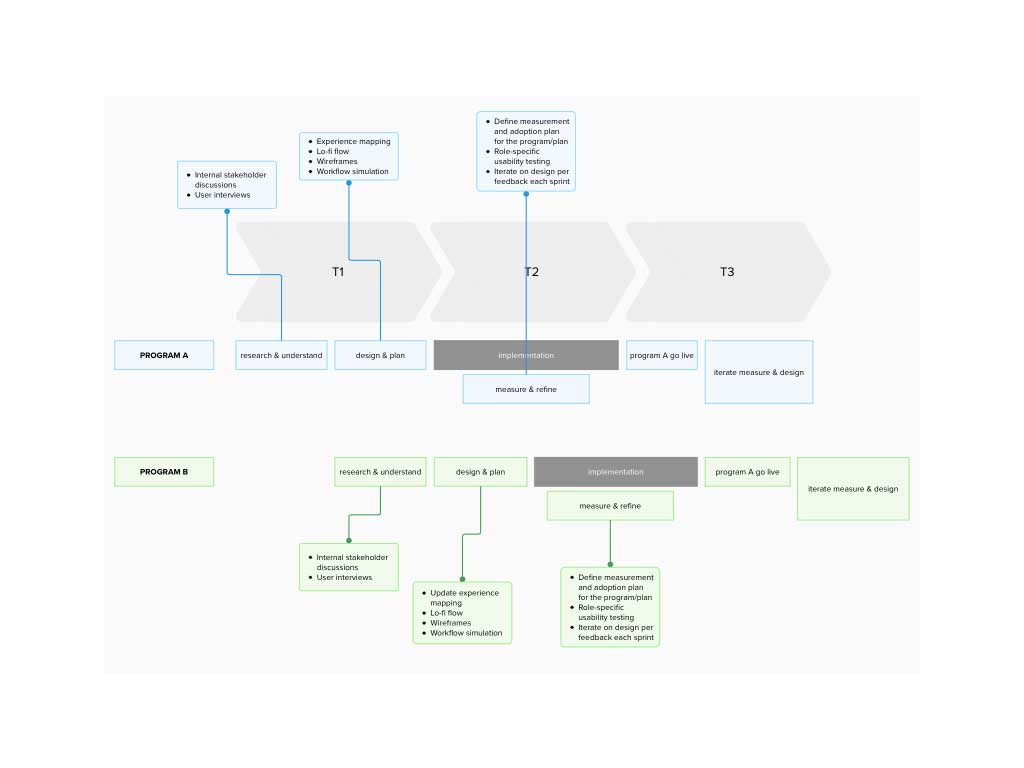
We planned for a phased rollout of the new system starting with one type of request which was used infrequently. I created a UX roadmap for future iterations so research could be integrated well before development began in later phases.
Workshop with departmental stakeholders to understand overlapping needs
Because of the complexity of the problem, we needed to understand the bigger picture of the processes involved before mapping.
Document current state flow to understand the scope
Creating a detailed current state flow would help us identify where we could consolidate information, which UI elements to prioritize and which would use out-of-the-box functionality.
Separate design tasks between configuration and customization
To leverage the existing platform capabilities while still allowing for unique requirements, we needed to separate the design tasks into configuration-only and customized components.
Create roadmap for UX integration into future PI planning.
The vendor development team was not used to working with UX teams, so we needed to create a clear roadmap for integrating UX into their planning process.
What changed.
No specific numbers I'm able to share, but the qualitative signals from leadership and the field were consistent.
UX tasks were prioritized and integrated into the development process with a roadmap to guide future iterations.
Early usability testing revealed areas for improvement and validated our design decisions.
Leadership became more invested in the UX process and provided space "at the table" for future iterations.
Development team members became more aware of UX principles and started incorporating them into their workflow.
My role.
UX strategist partnering with UX researchers, designers, product owners and departmental stakeholders
What I did
- Facilitated workshops with key stakeholders to align on problem statement, MVP scope and priorities
- Worked with business analyst to group ideas as actionable backlog items
- Worked with user researcher to build user journeys from the interviews he conducted
- Partnered with the product owner to ensure user interviews, mapping effort, wireframe design and usability testing were incorporated into PI planning
- Ran second set of workshops to determine evolution of the product (what would it be or not be)
What the team did
- Conducted user research and interviews
- Designed wireframes and prototypes iteratively
- Built the tool and pushed it to production
- Conducted usability testing sessions and synthesized findings for the team