Users had a plethora of support options but didn't know where to start.
Organization had multiple ways for employees to seek support including an intranet portal for corporate related knowledge, an intranet portal that included HR and IT knowledge, various chatbots on those portals, live chat plus, in-app guides and resources.
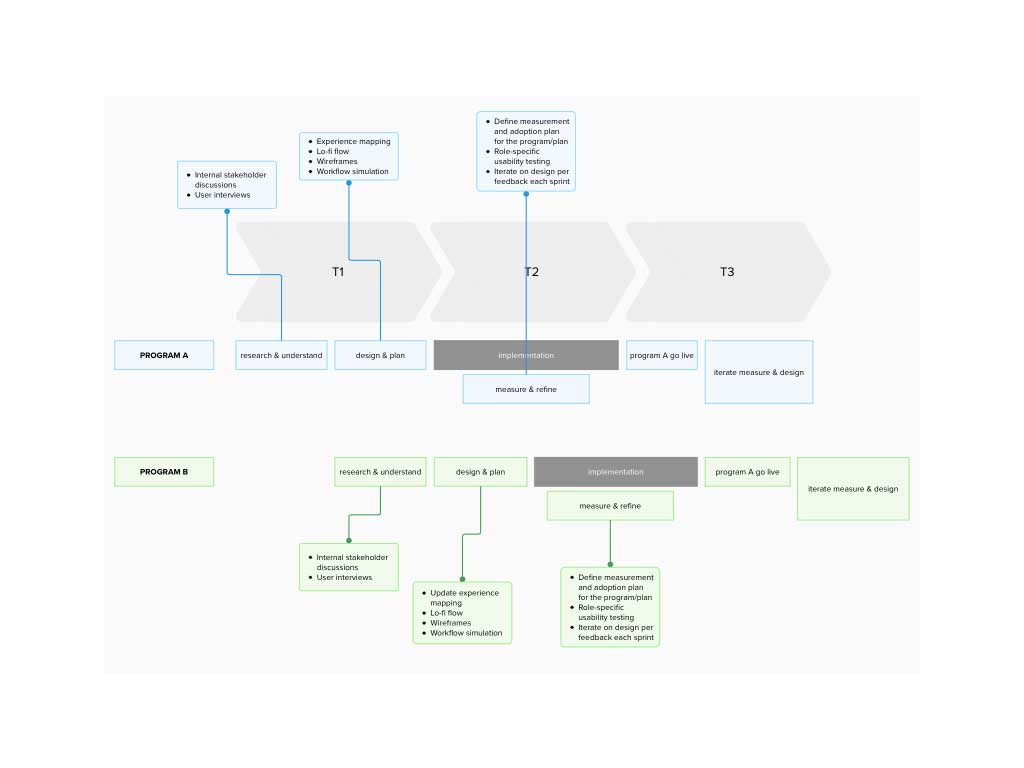
The frame.
Where we began and who was affected.
A proof of concept was created by an innovative, in-house developer for a "single pane of glass" idea that was later floated among leadership. The idea was raw and required refinement which is why our user experience team was brought in to help. Myself and a handful of other UX professionals, including a designer, researchers, content strategists and an accessibility specialist were tasked with helping shape the MVP and future of this tool.
- Employees called the Service Desk often for help and advice they could find in one of the various support portals offered.
- There was a lack of integration between different support systems.
- Understanding who within the organization would be able to help with a specific issue was challenging.
- Ticket routing was not always correct.
To be successful, we would need to ensure the new tool was intuitive and provided the correct information to maximize adoption.
"There's a wealth of information out there but no one can find it." Service Department Leader
Who I talked to.
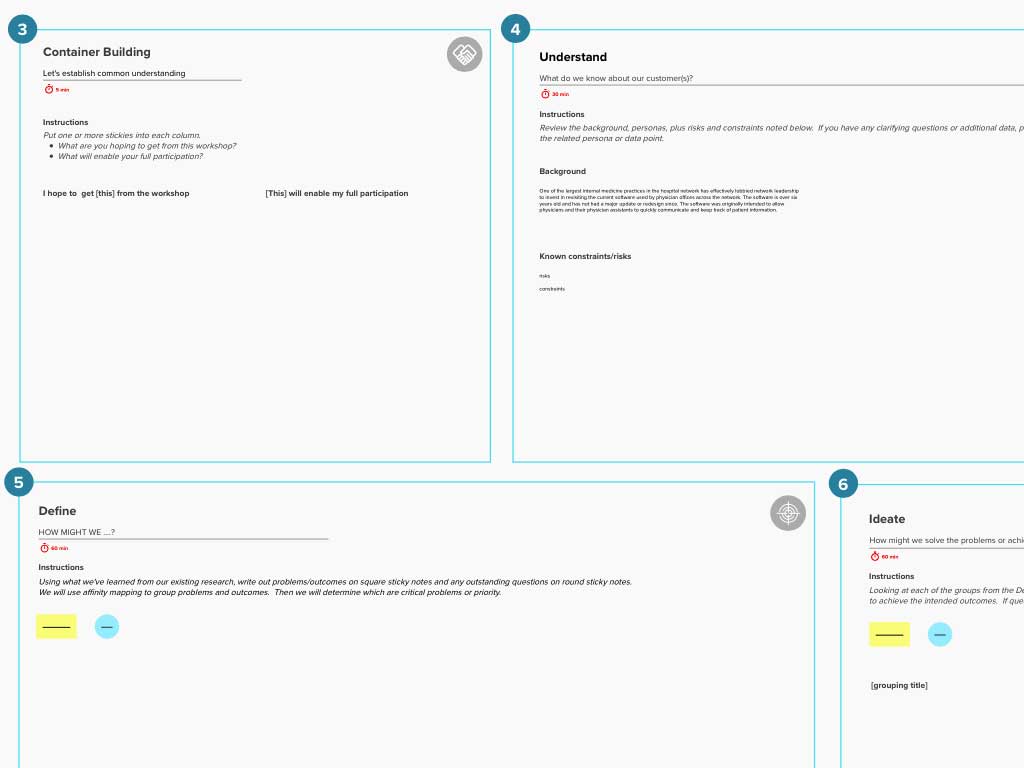
I conducted a workshop with key stakeholders such as Service Department Leaders, our Product Manager and Owner, the development team, the UX team and enterprise architecture.
Workshop details
- Built the framework for the workshop in Mural leveraging design thinking principles
- Conducted 3 virtual workshops and moderated discussions with key stakeholders
- Aligned on the problem statement
- Determined the MVP scope and subsequent priorities
What we found.
These are the key insights from the workshop and interviews.
Users did not know the difference between chatbots and live chat.
The distinction between automated and human assistance was unclear to users which caused confusion and ultimately, a call to Service. The interfaces were not distinct enough to provide clear guidance.
Even service representatives faced challenges providing correct information occasionally.
Service representatives struggled to locate the correct information if it was something they did not regularly work with.
Routing to correct department was unclear.
Employees used a directory on the intranet to find the right resources to contact, but the information was not always up-to-date or easy to navigate.
Where we landed.
We planned for an AI-powered service hub that interpreted employee questions and routed them to the right answer, ticket, team, or live channel across SharePoint, ServiceNow, Salesforce, and Pendo — with real-time wait times surfaced in context.
Document current state to verify assumptions
We wanted to know where we were starting from and validate our understanding before proceeding with the implementation.
Create wireframe keeping technological constraints in mind
We needed to work with the developer who created the POC to understand the technical limitations and possibilities before designing the solution.
Test early and often
Ensured usability testing was integrated throughout the development process to ensure MVP would be received well.
Build in flexibility for future needs
Because technology evolves rapidly, we needed to ensure our solution could adapt to changing requirements and integrations.
What changed.
No specific numbers I'm able to share, but the qualitative signals from leadership and the field were consistent.
It took a few iterations to get right but early adopters started to see the value.
This effort was prioritized for the following PI with the support of senior management going to broader audience in next quarter.
My role.
UX strategist partnering with UX researchers, designers, content strategists, accessibility specialists, product management and service leaders
What I did
- Facilitated workshops with key stakeholders to align on problem statement, MVP scope and priorities
- Worked with business analyst to group ideas as actionable backlog items
- Worked with user researcher to build user journeys from the interviews he conducted
- Partnered with the product owner to ensure user interviews, mapping effort, wireframe design and usability testing were incorporated into PI planning
- Ran second set of workshops to determine evolution of the product (what would it be or not be)
What the team did
- Conducted user research and interviews
- Designed wireframes and prototypes iteratively
- Built the tool and pushed it to production
- Conducted usability testing sessions and synthesized findings for the team